
Tired But Wired? How Herbs Can Support a Sensitive Nervous System
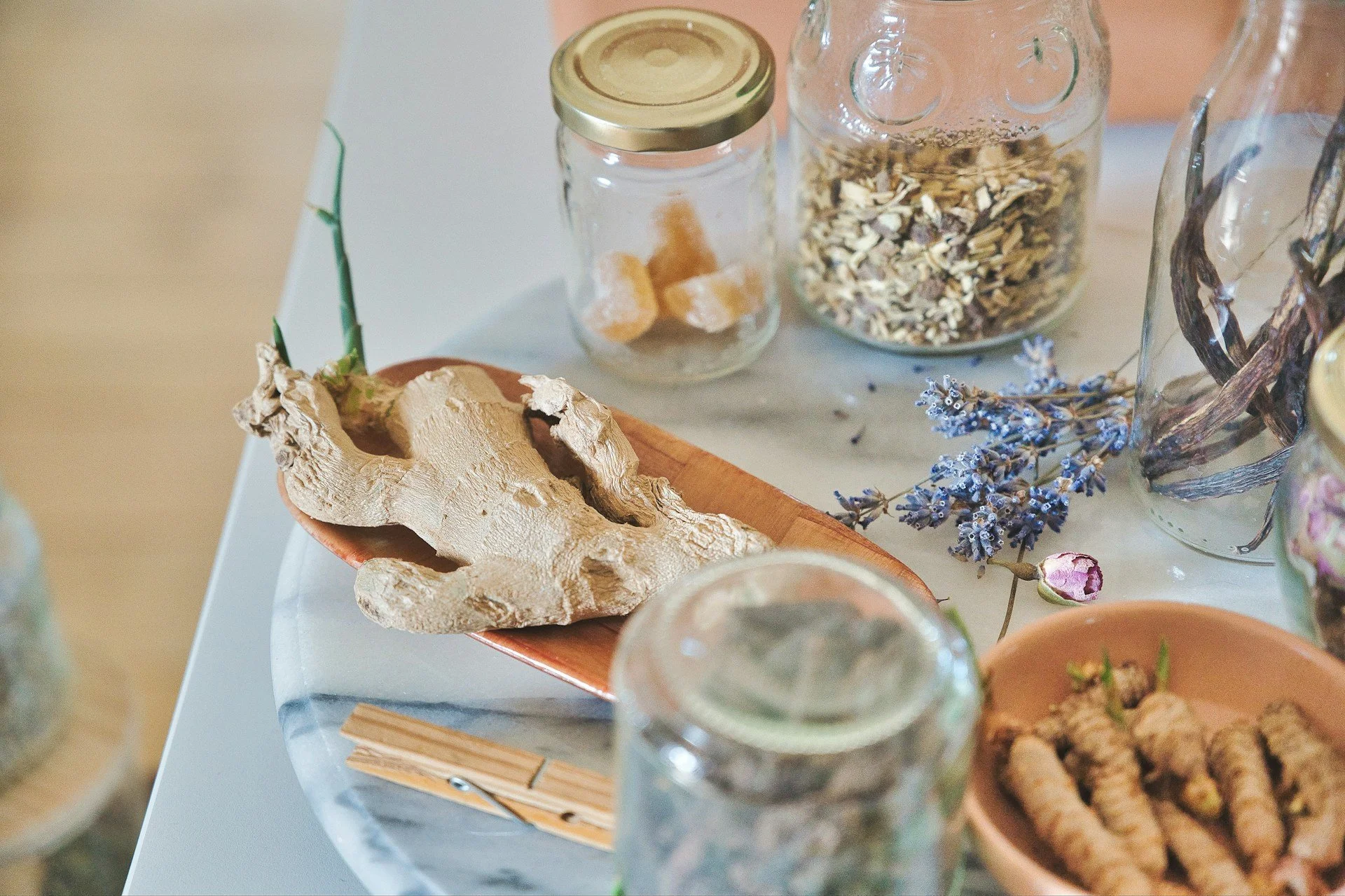
My local herbal shop is becoming one of my favourite places, and my conversations with Charlotte are the reason why.
I keep finding myself in this beautiful herbalist shop in my local town centre of Leek and finding an excuse to buy loose leaf teas and tinctures – it feels like an actual treat (unlike the sugar filled pistachio cake that the café next door keep flaunting).
My latest thing is needing more sleep and something to take the edge off occasional anxiety, so I’ve bought a valerian root tincture and some beautifully fragrant rose and lemon balm tea. So good. On the first night I had the maximum dosage of valerian root and was unbelievably drowsy. Turns out I just need three drops not three pipettes.
The shop owner, Charlotte, is a medical herbalist who specialises in supporting sensitive and neurodivergent people, and I love picking her brain about the herbs I'm buying. She told me that lemon balm (Melissa officinalis) is a nervous system trophorestorative – meaning it actively restores the nervous system rather than just calming it down. It's been scientifically proven to reduce anxiety and overstimulation by increasing GABA levels in the brain – a neurotransmitter that tells brain cells to slow down, producing a calming effect. It can also improve sleep and support mental clarity when you're feeling stressed. If sleep is your thing, Charlotte recommends combining rose, lemon balm, and chamomile flowers into a tea blend. For me, the rose has a nostalgic Turkish delight scent that takes me straight back to childhood holidays.
She also introduced me to oat flower tops (Avena sativa), another nervine trophorestorative that nourishes and restores depleted nervous systems – particularly helpful if you're feeling tired but wired, or battling stress, anxiety, and exhaustion. They can also support mental clarity on days when your brain feels foggy. You can blend oatstraw with red clover and skullcap for a tea, or use a tincture added to water. Charlotte describes them as essentially feeding the nerves.
There is so much to learn about the hundreds of herbs that can support sensitive people, and I was so glad when Charlotte agreed to join me for a proper conversation about it. If you struggle with chronic fatigue or fibromyalgia, have ADHD or attention difficulties, or your mental health could do with a bit of nurture, it’s worth watching. We talked about Charlotte's own journey – from fibromyalgia and burnout to stability, good health, and a thriving business – and got into what a typical patient might need, the plants that crop up most often (pun absolutely intended), and the biological mechanisms behind how some of these herbs interact with the human body. If you're a science geek like me, you'll find it fascinating. You can watch it here on YouTube.
Charlotte is also very kindly offering my clients 10% off an initial consultation – you can find out more about working with her at https://www.homestead-herbal.org
I hope you enjoy the conversation as much as I did. Herbs can be a genuinely powerful support for highly sensitive people, especially when used alongside therapy or coaching, and this is a good example of how a blend of different approaches can create real, lasting change.
Love,
Hayley
References
Jibril, A. T., Arero, A. G., Kankam, S. B., & Fuseini, M. (2022). Effect of Avena sativa (oats) on cognitive function: A systematic review of randomized controlled trials. Clinical Nutrition ESPEN, 53, 144–150. https://doi.org/10.1016/j.clnesp.2022.12.011
Kennedy, D. O., Bonnländer, B., Lang, S. C., Pischel, I., Forster, J., Khan, J., Jackson, P. A., & Wightman, E. L. (2020). Acute and chronic effects of green oat (Avena sativa) extract on cognitive function and mood during a laboratory stressor in healthy adults: A randomised, double-blind, placebo-controlled study in healthy humans. Nutrients, 12(6), 1598. https://doi.org/10.3390/nu12061598
Mathews, I. M., Eastwood, J., Lamport, D. J., Cozannet, R. L., Fanca-Berthon, P., & Williams, C. M. (2024). Clinical efficacy and tolerability of lemon balm (Melissa officinalis L.) in psychological well-being: A review. Nutrients, 16(20), 3545. https://doi.org/10.3390/nu16203545
Scholey, A., Gibbs, A., Neale, C., Perry, N., Ossoukhova, A., Bilog, V., Kras, M., Scholz, C., Sass, M., & Buchwald-Werner, S. (2014). Anti-stress effects of lemon balm-containing foods. Nutrients, 6(11), 4805–4821. https://doi.org/10.3390/nu6114805
